Scene 03 · Now hear it from them
They were eleven.
Not a gallery. A reveal. Meet the children first, notice how young they are, then open their work and read what they actually wrote.
Hi, this is Mrs. Martinez, the high school English teacher who somehow ended up teaching a room full of 11-year-olds "codes" for analyzing literature and writing like high schoolers. Maybe even better.
Now, calling them codes wasn't exactly my plan. But the kids decided that's what they were, and suddenly we had a secret language. They had the inside scoop on how scholars think, talk, and write. I saw my opening and thought, Well...we're going with this.
That's what I loved about 6th graders.
They were still wonderfully quirky and real. Still innocent enough to be goofy, eager to please, laugh at ridiculous things, and blurt out an idea before worrying whether it sounded "smart." They weren't nearly as self-conscious as my high schoolers. They would take a chance, get it completely wrong, laugh, listen to somebody else, and try again.
And that was my in.
Their quirkiness became the perfect recipe for a wonderfully wild learning environment, one where thinking hard and having fun somehow belonged in the same room. We had fun.
Once I realized how special that was, I held onto it for dear life. I wanted to protect the wonderful weirdness of being 11 for as long as I possibly could.
Because somewhere inside all that silliness, they were becoming scholars.
They just didn't know it yet. Through games and fun conversations, they created a world of their own that was safe to be ourselves.
Mrs. Martinez
One year on
They came back to tell her themselves.
Here they are, speaking in code, haha, sharing their thoughts on how their learning of simple systems has supported their work as 7th, 8th, 9th and 10th graders coming to visit my last year at their elementary school in 2023.
Visiting seventh graders Room E-5, 2023 4 min 08
Or hear each of them on their own.
Further on
The same systems, in high school.
Several of them describe using the codes in ninth grade, before their classmates were taught them.
Wait. These are sixth graders? They wrote those analyses?
Every piece below is real student work from Room E-5, dated, unedited, and printed in the book. Open each one in order. The distance between the first and the last is about eight months of daily practice.
Read the fable and tell me what the author wants you to understand.
SW #25 · July 2019 · age 11
SW #25 · July 2019 · age 11
Prompt → Read the fable and tell me what the author wants you to understand.
What to noticeA retelling. Accurate, and entirely summary. Nothing here says what the fable means or why it matters.
Write an analysis paragraph of the life lesson the author wants to relay, citing evidence, using the TBEAR structure.
Class model paragraph · Room E-5
Class model paragraph · Room E-5
Prompt → Write an analysis paragraph of the life lesson the author wants to relay, citing evidence, using the TBEAR structure.
What to noticeSame fable. Same age. A claim, cited evidence, an explanation of meaning, a reason it matters, and a restatement.
Analyze this quote by Maya Angelou and explain its significance.
Alex F. · August 7, 2018 · age 11
Alex F. · August 7, 2018 · age 11
Prompt → Analyze this quote by Maya Angelou and explain its significance.
What to noticeAlex is the student who opened the year with "This is stupid! I don't know why we have to learn this." Four sentences in, he is already citing and paraphrasing.
Looking back.
Alexander F. · 10th grade · 2022-23
Alexander F. · 10th grade · 2022-23
Prompt → Looking back.
What to noticeThe catalyst for the whole book, reporting back from high school.
Analyze "I Have Only Just a Minute" by Dr. Benjamin E. Mays.
Evelyn M. · 6th grade, 2022-23 · written in 8th grade
Evelyn M. · 6th grade, 2022-23 · written in 8th grade
Prompt → Analyze "I Have Only Just a Minute" by Dr. Benjamin E. Mays.
What to noticeThis is the moment most readers stop and ask the question this website was built around. These are sixth graders?
The writing final
One essay, start to finish, by an eleven-year-old.
Nothing below is corrected, tightened, or shortened.
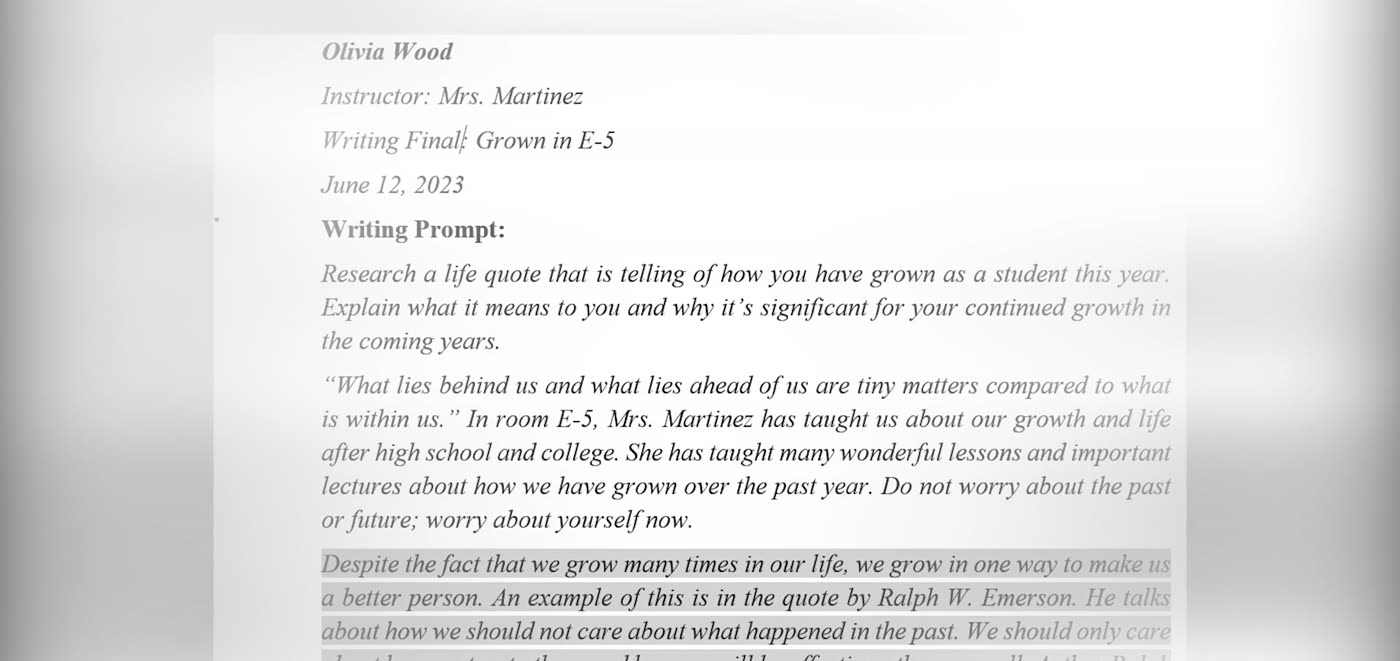
Olivia W.
Writing Final: Grown in E-5
Writing Prompt: Research a life quote that is telling of how you have grown as a student this year. Explain what it means to you and why it’s significant for your continued growth in the coming years.
In Olivia’s own voice
Press play to listen. Each word lights up as Olivia reads.
“What lies behind us and what lies ahead of us are tiny matters compared to what is within us.” In room E-5, Mrs. Martinez has taught us about our growth and life after high school and college. She has taught many wonderful lessons and important lectures about how we have grown over the past year. Do not worry about the past or future; worry about yourself now.
Despite the fact that we grow many times in our life, we grow in one way to make us a better person. An example of this is in the quote by Ralph W. Emerson. He talks about how we should not care about what happened in the past. We should only care about how we treat others and how we will be affecting others as well. Author Ralph W. Emerson notes, “What lies behind us and what lies ahead of us are tiny matters compared to what is within us,” and this reflects on my time in E-5 by how different people we were in 5th grade. Mrs. Martinez has taught us how important it is to grow and live uncomfortably rather than live comfortably and never grow. The quote demonstrates how we look within ourselves, or we should not worry about what lies ahead or what was left behind us. We have to watch ourselves right now, in the moment. Emerson suggests that we should never worry about if something happened in the past or worry about how our life will be in the future; all we need to worry about is ourselves. How we look at ourselves is not on the same level as the past or future. It is above that.
Finally, never worry about how you were in the past. Worry about yourself right now. In room E-5, Mrs. Martinez has taught us about growth and life after high school and college. She has taught many wonderful lessons and important lectures about how we have grown over the past year. What this year has meant to me is: What lies behind us and what lies ahead of us are tiny matters compared to what is within us.
What to noticeA sixth grader, eleven years old, closing her final by folding the quote back into her own sentence. This is the assignment that makes the case for the whole book: the prompt asked for research, meaning, and forward significance, and she answered all three.
Years later
The same students, reporting back from high school.
Written between four and six years after they left sixth grade, unprompted and unedited.
TBEAR has helped me be able to write all that's on my mind and making it make sense to the readers. Because of TBEAR and the method you taught us, I am able to write essays and prompts without any struggle or writer's block.
TBEAR and SMM has helped me greatly throughout my high school English classes as well as my chemistry class. TBEAR has made me achieve many goals in writing that I thought I would never conquer.
Out of all the teachers I had experience with, none of them went into as much depth into writing as Mrs. Martinez did. Seeing how quick and easy it was to write made me realize how much I've grown. I still use what Mrs. Martinez has taught me to this very day.
One poem, two generations
A valedictorian was asked why she invited her sixth-grade teacher to her graduation.
Her answer was the Time poem, taught to Catherine as a child by her own mother, Ana.
"I don't remember your explanation. I remember Cameron explaining the poem to me."
It was not the teacher's words that stayed. It was the conversation between two students, an exchange that was never in the lesson plan and that the teacher barely noticed at the time.
Twenty years later, another sixth grader analyzed the same poem in the same classroom. Both of their reflections are in the book, printed side by side.
Teachers rarely witness the full impact of the conversations taking place among their students. We may never know which discussion, which question, or which peer explanation becomes the moment that changes the course of a child's life.
Next · Scene 04
The Framework
Now the question everyone asks. How did eleven-year-olds get here?